Cybersecurity first. A safer online world for all. Practical tools and guides for a digital future. A 2026 Champion of Cybersecurity Awareness Month. What you check stays on your phone or computer.

A digital inclusion report · First edition

The Digital Trust Deficit

Who carries the cost of online scams?

Online scams reach everyone, and the harm is not shared equally. This report brings together figures from 31 countries on who scams reach, who is protected and who recovers, what has already cut losses, thirteen changes that would help, and a toolkit that sets every free UtilForge.org tool beside the problem it helps with. Every figure is dated, sourced and labelled as a reported loss, a survey estimate, a modelled estimate or a company figure. The 28 October update adds what 5,000 adults in five countries say about their own protection, from the Oh, Behave! 2026 survey.

Resumen en español: lo que enseña América Latina y el Caribe

Download the report (PDF, 1.7 MB) Read it in your browser Email me the next report

The report is open to everyone and needs no email address. The email button is optional: it sends you the next report when it is published.

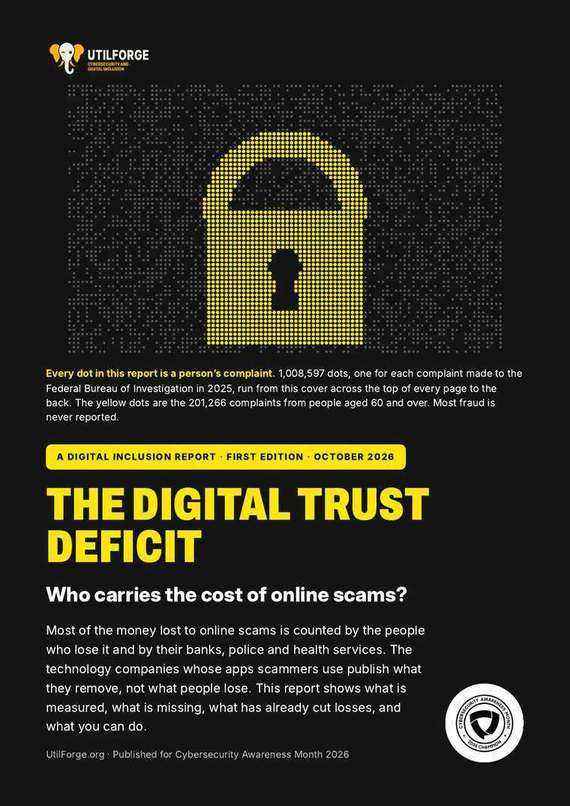
The report cover: a padlock made of yellow dots on a black page, with the title The Digital Trust Deficit, who carries the cost of online scams?

What the report finds

18.1% vs 12.9%of people with disabilities in Australia experienced personal fraud in a year, against people without disability. In all four countries that measure it, people with disabilities experience more fraud.
39% vs 20%of bank-fraud victims in the United States who could not cover a US$400 emergency did not get all their money back, against victims with three months of savings.
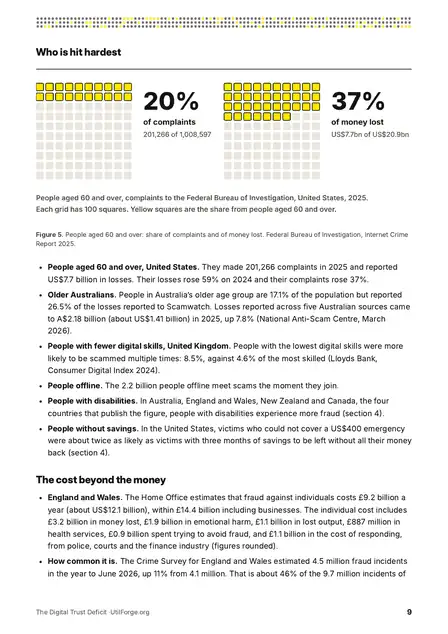
1 in 5complaints to the Federal Bureau of Investigation in 2025 came from people aged 60 and over, and those complaints carried 37% of the money reported lost, US$7.7 billion.
200 millionmore women than men do not use mobile internet in low- and middle-income countries, and women name safety and security as their top barrier.
0 of 7large technology companies reviewed publish the money people lost to scams on their services, the refunds paid, or the revenue from adverts later removed as scams.
54% → 65%of scam losses by value are refunded in the United Kingdom since banks were made to pay, and 97% of the claims the rule covers.
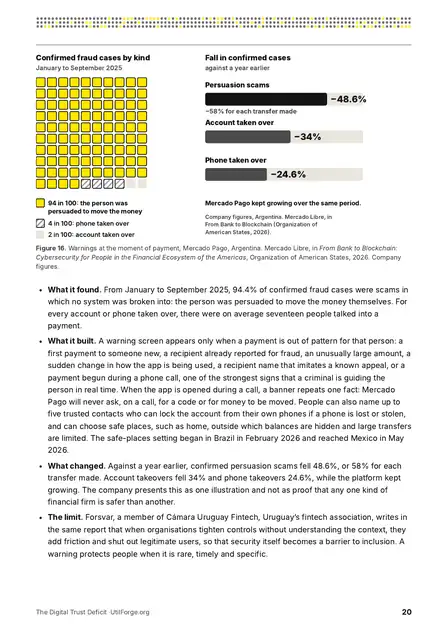
−48.6%fall in persuasion scams at Mercado Pago, a payment app in Argentina, in 2025, after warnings were built into the moment of payment. Company figures, from the Organization of American States’ 2026 report From Bank to Blockchain.
68% → 81%of people in Latin America and the Caribbean used the internet between 2019 and 2023, and the World Bank describes the region as the fastest-growing for disclosed cyber incidents. Inclusion and exposure grow together.
64% vs 33%of adults in Generation Z, against baby boomers, said they had lost money or data to scams in a 2026 survey of 5,000 adults in five countries. Younger adults say it happens to them more often; older people lose more each time.
71% vs 41%feel confident spotting a scam text, but only 41% always or very often report phishing, and 47% use multi-factor authentication regularly.
88%of people who had cybersecurity training found it useful, and 49% then started using multi-factor authentication. Half of adults have no access to training.

The people most affected are also the least counted. Most fraud agencies do not publish losses by disability, sex, income or language, so the cost is counted by the people who lose the money and by their banks, police and health services.

Every dot in the report is a person’s complaint. 1,008,597 dots, one for each complaint made to the Federal Bureau of Investigation in 2025, run from the cover across the top of every page to the back. The yellow dots are the 201,266 complaints from people aged 60 and over. Most fraud is never reported.

Inside the report
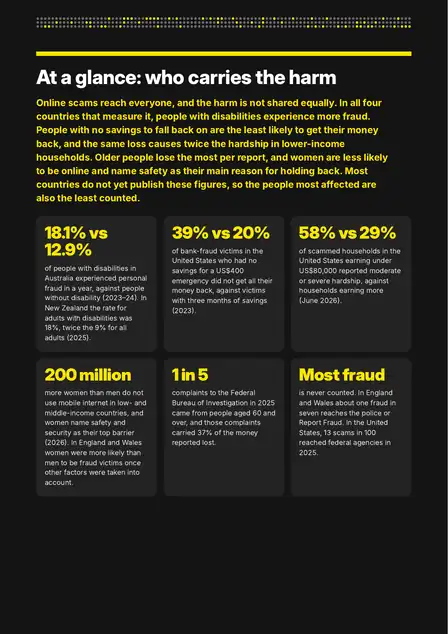
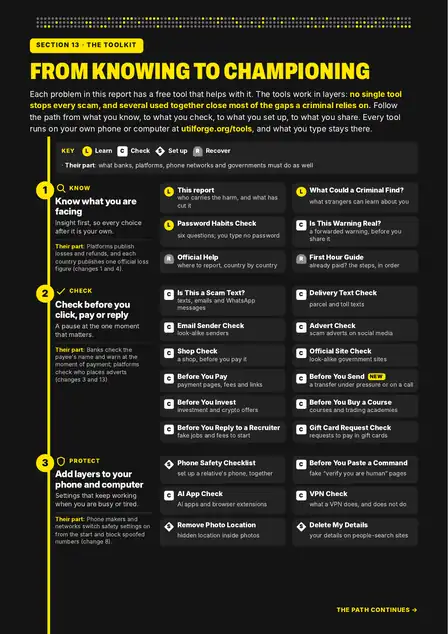
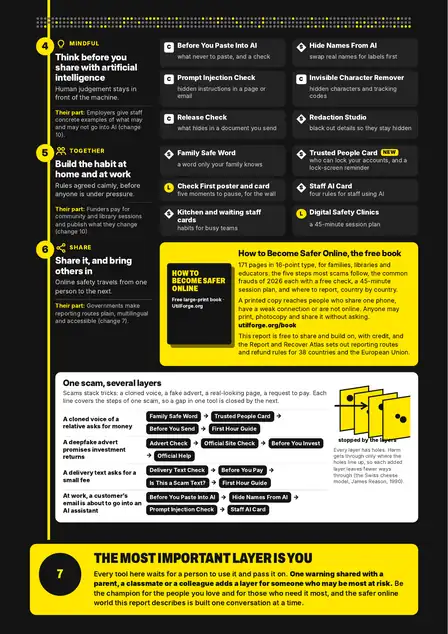
Page 2: At a glance, who carries the harm, with six headline figures Page 38: the toolkit, from knowing to championing, left page: stages one to three, know, check and protect, with the free tools for each Page 39: the toolkit, right page: stages four to six, mindful use of artificial intelligence, habits at home and at work, and sharing, the free book, one scam with several layers, and the most important layer, you Page 20: warnings built into the app in Argentina, with 94 in 100 confirmed fraud cases being persuasion scams and a 48.6% fall in them Page 9: Who is hit hardest, with the share of complaints and money lost by people aged 60 and over
  1. If it has just happened, and what you can do this week
  2. Why this report
  3. What is known
  4. Who is reached, who is protected, who recovers
  5. Most fraud is never counted
  6. Who carries the cost, and what changes it
  7. What platforms publish, and what others found
  8. Around the world: institutions in their own words
  9. Charities, libraries and journalists
  10. From a scam to lost trust
  11. Thirteen changes that would help
  12. Find your place
  13. The toolkit: from knowing to championing
  14. How to read the figures, and how this report was made

If it has just happened

Stop all contact. Call your bank on the number printed on your card. Report the scam and say where it began. The first-hour guide puts the steps in order for your country, and the official help page lists where to report in 33 countries and territories.

The toolkit: free checks that go with the report

Section 13 is a double-page toolkit. It sets UtilForge.org’s free tools along a path, from knowing what you face, to checking before you pay, to adding layers to your phone, to thinking before you share with artificial intelligence, to habits at home and at work, to sharing what you know. No tool is scored; each stage names what banks, platforms, phone networks and governments must do as well. The most important layer is you.

Press release

Read the launch release, distributed by EIN Presswire on 26 October 2026: New report finds people with disabilities, people without savings and older people bear greater harm from online scams. Journalists will find the release, images and contact details on the press page. Also published by the National Law Review: New report finds people with disabilities, people without savings and older people bear greater harm from online scams.

Quote it, share it, build on it

The report is published under the Creative Commons Attribution 4.0 International licence: share it, quote it and build on it, with credit to UtilForge.org. Spokesperson and media contact: Lindsay McDonald, lindsay@utilforge.org. Journalists and researchers can write to her for the source table behind any figure.

Corrections

Every correction will be listed here with its date. Send corrections to Lindsay McDonald at lindsay@utilforge.org. UtilForge.org plans to update the report as new data and new laws arrive.

First edition published 26 October 2026. Updated 28 October 2026 with the Oh, Behave! 2026 survey. Updated 29 October 2026 with findings from the Organization of American States’ report From Bank to Blockchain, the World Bank and the International Monetary Fund, a thirteenth change, warnings built into apps, and the toolkit. Finding 3 in section 4 now compares Generation Z with baby boomers, in line with the rest of the report.