UtilForge.org offers free cybersecurity tools and practical guides, and is a registered 2026 Champion of Cybersecurity Awareness Month. This page holds the press releases, the facts, the images and the contact for journalists.
Report release, 26 October 2026
New Report Finds People With Disabilities, People Without Savings and Older People Bear Greater Harm From Online Scams
Distributed by EIN Presswire on 26 October 2026: read the release on EIN Presswire. Also published by the National Law Review on 26 October 2026: read the release on the National Law Review.
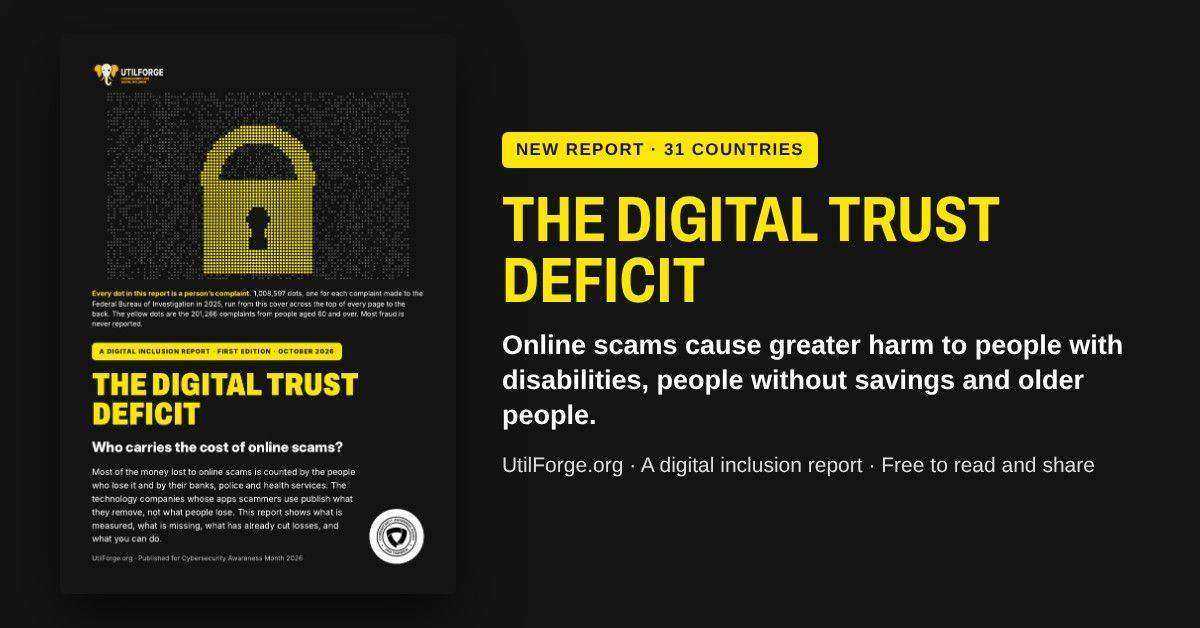
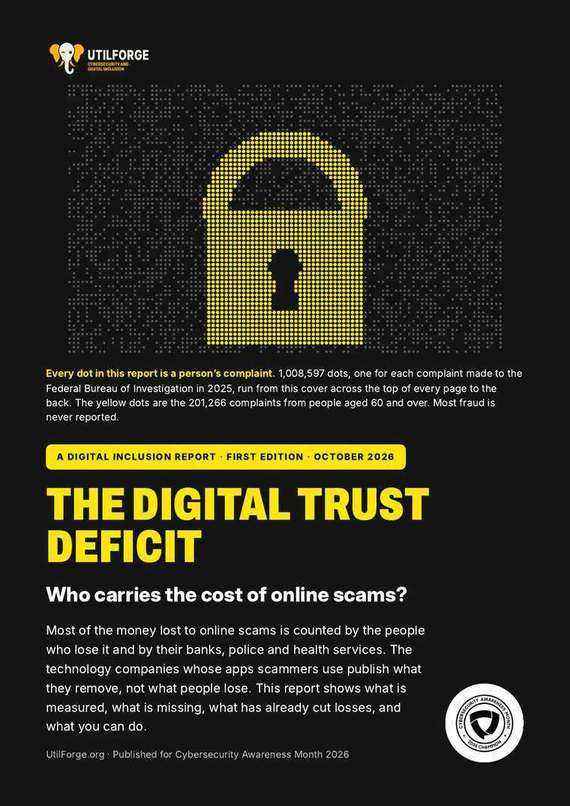
In Cybersecurity Awareness Month, The Digital Trust Deficit shows who scams reach, who is protected and who recovers in 31 countries, and twelve changes.
Online scams reach everyone, and the harm is not shared equally. The Digital Trust Deficit: who carries the cost of online scams?, a new report from UtilForge.org, finds that people with the least to fall back on are hurt most and are the least likely to get their money back.
In the United States, 39.2% of bank-fraud victims who could not cover a US$400 emergency did not get all their money back, against 20.0% of victims with three months of savings, according to the Federal Reserve Bank of Kansas City. In a Gallup survey conducted for the Stop Scams Alliance, 58% of scammed households earning less than US$80,000 reported moderate or severe hardship, twice the proportion among higher-earning households.
Older people carry a larger share of the losses. People aged 60 and over made one in five complaints to the Federal Bureau of Investigation in 2025 and reported 37% of the money lost, US$7.7 billion. Across low- and middle-income countries, about 200 million more women than men do not use mobile internet. Women also name safety and security as their top barrier to using it, according to the GSM Association.
People with disabilities experience more fraud in the four countries that publish the figures. In Australia, 18.1% of people with disabilities experienced personal fraud in a year, against 12.9% of people without disability. In New Zealand, 18% of adults with disabilities experienced fraud in 2025, twice the 9% for all adults.
The people most affected are also the least counted. Most fraud agencies do not publish losses by disability, sex, income or language. Of the seven large technology companies reviewed, none publishes the money people lose to scams on its services, the refunds paid to victims or the revenue from adverts later removed as scams. The cost is counted instead by the people who lose the money, and by their banks, police and health services.
In the United States, reported losses to internet crime reached US$20.9 billion in 2025, according to the Federal Bureau of Investigation. In England and Wales, the Home Office estimates the cost of fraud to individuals at £9.2 billion a year.
The report also documents measures that have reduced losses. In the United Kingdom, since banks were required to refund most victims of bank-transfer scams in October 2024, the share of losses refunded by value has risen from 54% to 65%, and 97% of the claims the rule covers have been refunded, according to the Payment Systems Regulator and the independent evaluation it commissioned.
In Taiwan, the investment scam adverts detected each week fell from 77,484 at their 2024 peak to 388 in June 2026, after a law required platforms to check who places adverts.
Institutions in South Africa, Nigeria, Kenya, Ghana, India, Singapore, Hong Kong, Brazil and the European Union appear in the report in their own published words and figures.
"A safer online world should be developed for the people who carry the most harm. This report brings together the published evidence so that more people have access to the information to make informed choices," said Lindsay McDonald, spokesperson for UtilForge.org.
The report proposes twelve changes, each naming the institution responsible for acting. They include audited yearly disclosure by technology platforms of scam losses, refunds and advert revenue; reporting routes in plain language and in other languages; and fraud figures published by age, disability and language. The report opens with the first steps for anyone who has just been scammed, and where to report in each country.
Alongside the report, UtilForge.org makes free checks available to all, running on the user's own device, including Advert Check, for search engine and social media adverts, and Is This the Official Government Site?
Read and download the report: utilforge.org/reports/digital-trust-deficit
About UtilForge.org
UtilForge.org is a digital inclusion organisation offering free cybersecurity and online safety tools and guides, and is a registered 2026 Champion of Cybersecurity Awareness Month, a programme of the National Cybersecurity Alliance. The report is published under the Creative Commons Attribution 4.0 International licence.
Report page · Download the report (PDF) · Share image, 1200 by 628 · Cover image
Book release, 20 October 2026
Cybersecurity Awareness Month Brings a Free Large-Print Book for a Safer Online World
How to Become Safer Online, a free large-print guide that anyone may download, print and share, is a contribution from UtilForge.org, a registered 2026 Champion of Cybersecurity Awareness Month.
Cybersecurity Awareness Month is led in the United States by the Cybersecurity and Infrastructure Security Agency and the National Cybersecurity Alliance, a non-profit, under this year's theme, "Don't Make It Easy for Them". European Cybersecurity Month runs across the European Union in the same month, coordinated by the European Union Agency for Cybersecurity, focused this year on the workplace.
UtilForge.org has published How to Become Safer Online, a free cybersecurity awareness book for families, libraries and educators, to follow the free online safety tools it made available worldwide on 1 October 2026. The book is set in 16-point type, in line with the large-print guidance of the Royal National Institute of Blind People, the United Kingdom's sight loss charity, and anyone may print, photocopy and share it without asking permission.
In November 2025 the International Telecommunication Union, the United Nations agency for digital technologies, reported that about 6 billion people use the internet and that 2.2 billion are still offline, 96 per cent of them in low- and middle-income countries. UtilForge.org holds that every person who comes online should be able to bank, study, apply for work, browse and stay in touch with family in safety. In April 2026 the Federal Bureau of Investigation reported that Americans lost $20.9 billion to online crime in 2025, 26 per cent more than in 2024, and that people aged 60 and over reported almost $7.75 billion of those losses. In May 2026 the European Union Agency for Fundamental Rights found that one person in four in the European Union has been a victim of online fraud, and that only 15 per cent of victims reported it to the police.
In the book, Part One explains the five steps that most scams follow, and why spotting any one of them is reason enough to stop and check. Part Two covers the common frauds of 2026, each with a free check. Part Three is for educators and for the person a family turns to, with a suggested forty-five-minute session plan for a kitchen table or a library and a chapter on agreeing a family safe word. Part Four is for anyone who has already lost money or details, starting with the first phone call and listing where to report fraud country by country, a list also kept at utilforge.org/official-help, which links to guidance from the Cybersecurity and Infrastructure Security Agency and the European Union Agency for Cybersecurity. Part Five covers blacking out a document properly, what to paste into an artificial intelligence assistant, and the hidden instructions that web pages and emails can carry.
A printed copy can reach people who share a single phone, have a limited connection or are not online, and can be handed out at a library, community centre, care home or careers office. Every tool and check the book describes runs free at UtilForge.org on the reader's own phone or computer, and what the reader types stays on that device.
"Every warning passed on, and every safety tool shared with a family member, a classmate or a colleague, widens access to online safety," said Lindsay McDonald, spokesperson for UtilForge.org. "A safer online world is built one conversation at a time, by the librarian, the careers adviser, the neighbour and the family member everyone reaches out to. We hope this book encourages others to do more within their own spheres of influence, and contributes to broader digital inclusion."
How to Become Safer Online is free to download at utilforge.org/book. Any organisation is welcome to print the book for the people and community it serves, provided it is shared whole and unchanged and nobody is charged more than the cost of printing.
About UtilForge.org
UtilForge.org makes free cybersecurity tools and practical guides that run on people's own phones and computers, helping them check messages, job offers, payments, documents and the use of artificial intelligence before they act. UtilForge.org is a registered 2026 Champion of Cybersecurity Awareness Month, a programme of the National Cybersecurity Alliance, and takes part in European Cybersecurity Month independently.
Spokesperson and contact: Lindsay McDonald, lindsay@utilforge.org.
Mentions
UtilForge’s free tools were mentioned in a news item titled “CISA and ENISA launch cybersecurity awareness campaigns as global fraud losses hit $442B”, shown on the platform of Spain’s national entrepreneurship office (Oficina Nacional de Emprendimiento), startups.one.gob.es, around 1 October 2026. The item reported on the October awareness campaigns of the Cybersecurity and Infrastructure Security Agency in the United States and the European Union Agency for Cybersecurity. See the news page on startups.one.gob.es.
ThreatCluster, a website that gathers news stories automatically, mentioned UtilForge in a group of stories titled “October Marks Cybersecurity Awareness Month in United States and Europe” on 2 October 2026. Software assembled the page, and it is not an article written by an editor. See the ThreatCluster page.
Facts
What it is. A set of free cybersecurity tools for checking a payment page, finding payments that keep coming out, using artificial intelligence without sharing names, and checking documents before they are sent or published.
How it works. Every tool runs on the person’s own phone or computer. What is typed into a tool stays on that device, and each tool keeps working with the internet switched off.
Free. Forty-six tools, the everyday ones first on the homepage. The full list is here.
Paid. Release Check, $29 for one person. Artificial Intelligence Tools for Work, $39 for one person or $119 for a team of up to ten, which includes Release Check. Family Safety Tools, pay what you want from $0. Pricing
Official help. Where to report a scam, in 33 countries and territories, with the four core steps from the United States Cybersecurity and Infrastructure Security Agency.
Cybersecurity Awareness Month. UtilForge is a registered 2026 Champion of the National Cybersecurity Alliance’s programme. Cybersecurity Awareness Month is led by the Cybersecurity and Infrastructure Security Agency and the National Cybersecurity Alliance.
The 2026 theme. “Don’t Make It Easy for Them”, as stated on the National Cybersecurity Alliance’s Cybersecurity Awareness Month page.
See it for yourself
Open any free tool, let the page finish loading, switch the internet off (aeroplane mode on a phone) and use the tool. It carries on working. Before You Pay and Release Check are good places to start.
Images
Cybersecurity Awareness Month 2026 Champion badge (Portable Network Graphics) · UtilForge preview image (Joint Photographic Experts Group, 1200 × 630)
Logos. Logo, dark background (Portable Network Graphics) · Logo, light background (Portable Network Graphics) · Horizontal logo (Portable Network Graphics) · Elephant mark only (Portable Network Graphics). Please use the logos unaltered.




About UtilForge
UtilForge.org: Cybersecurity first. A safer online world for all. Practical tools and guides for a digital future. The tools check payments, subscriptions, private details, documents and the use of artificial intelligence on the visitor’s own phone or computer, so nothing typed is uploaded. Its habit is Check first: a short pause when you pay, paste, sign, send or share. UtilForge is a registered 2026 Champion of Cybersecurity Awareness Month, which is led by the Cybersecurity and Infrastructure Security Agency and the National Cybersecurity Alliance. Website: utilforge.org. Media contact: Lindsay McDonald, spokesperson, lindsay@utilforge.org. Statements are given by Lindsay McDonald on behalf of UtilForge.org.
Contact
Write to Lindsay McDonald, spokesperson, at lindsay@utilforge.org, or to support@utilforge.org with “Press” in the subject.
Which UtilForge?
This is utilforge.org, free cybersecurity tools. Other websites use similar names, and this one is independent of them.
Free